MBA After 5+ Years of Experience:
From Employee to Leadership
How an MBA Supports the Move Into Managerial Roles
After 5+ years of work experience, professionals may have strong knowledge of their role, industry and day-to-day business activities. As their responsibilities grow, they may also need to manage people, lead projects, work with stakeholders and make broader business decisions.
An MBA can build on this experience by developing management, leadership, strategic and business skills for professionals preparing for their next career stage
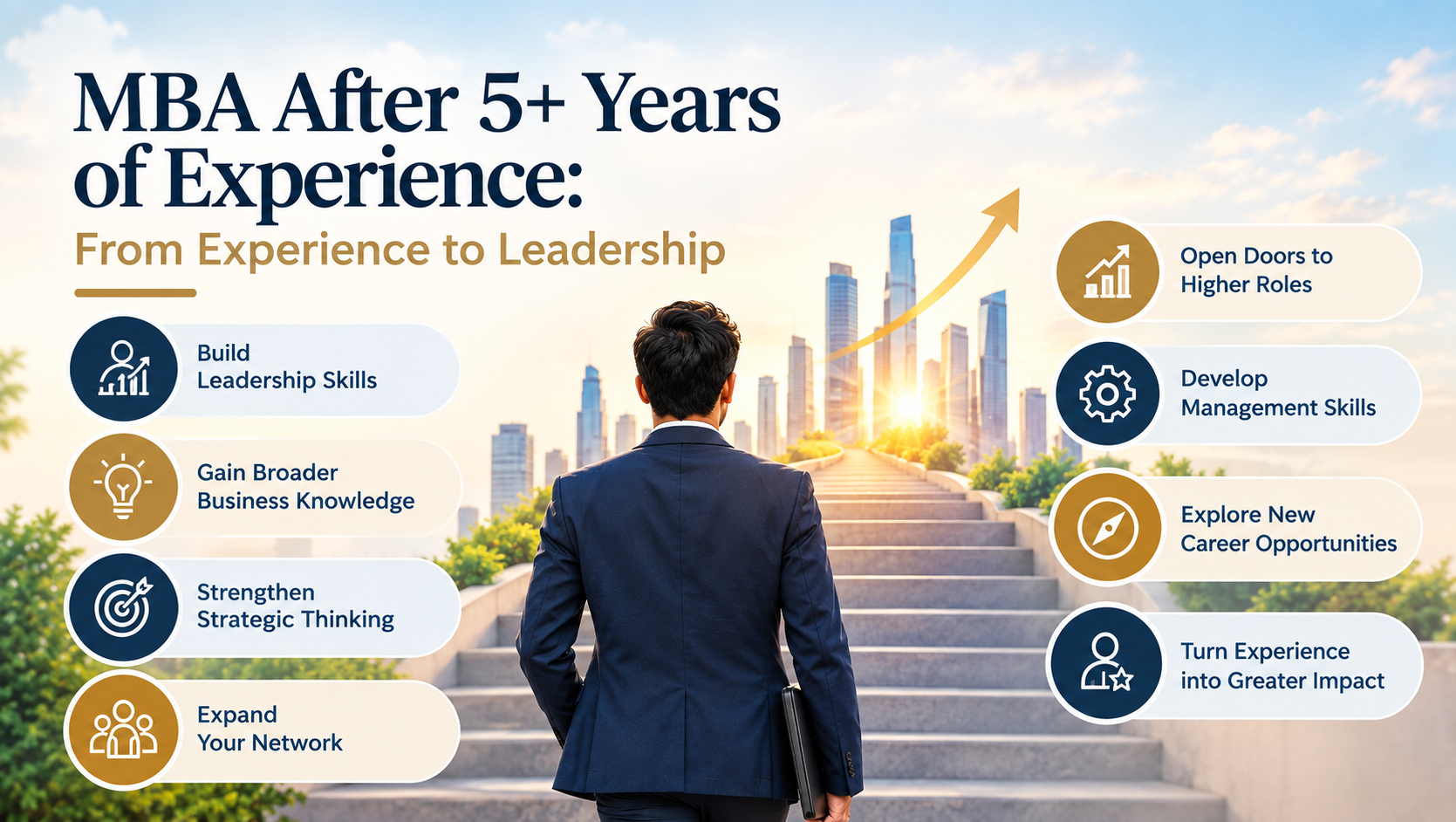
- Why 5+ years of experience can be a suitable stage to consider an MBA
- How an MBA can complement existing professional experience
- Skills that can support a move towards management responsibilities
- How an MBA can support career transitions and broader business roles
- Factors to consider before choosing an MBA programme
Career Growth After 5+ Years of Professional Experience
After 5+ years of professional experience, career growth can gradually shift a career from building functional expertise to taking on broader responsibilities. As professionals become more involved in projects, teams, clients, and business decisions, their development needs can also evolve.
Greater Responsibility
Professionals may move beyond assigned tasks and become accountable for processes, deliverables, and business outcomes. This can create a need for stronger management and business understanding.
Project Ownership
With experience, professionals may take greater responsibility for planning, coordinating, and delivering projects. Managing resources, timelines, risks, and outcomes can require capabilities beyond technical or functional expertise.
Team Coordination
Career progression can involve guiding colleagues, delegating responsibilities, and supporting team performance. This shifts the focus from individual contribution toward collaboration and people management.
Client and Stakeholder Management
As experience grows, professionals may have more opportunities to interact with clients, managers, vendors and other stakeholders. Managing expectations and communicating with different stakeholders can become an increasingly important professional skill.
Business Decision-Making
Experienced professionals may become involved in decisions related to budgets, operations, customers, processes and business performance.
Cross-Functional Involvement
Professionals may work more closely with functions such as finance, marketing, HR, operations and business development. Understanding how these functions connect can become important when responsibilities extend beyond a single area of expertise.
How an MBA Builds on Your Work Experience
Work experience can build strong knowledge of a professional's function, industry and workplace. An MBA can build on this experience by providing broader knowledge of management and how different business functions work together.
| What Work Experience Builds | What an MBA Can Add | How They Complement Each Other |
|---|---|---|
| Functional Depth | Broader Business Knowledge | Connects specialised expertise with a wider understanding of business operations. |
| Industry Context | Business Strategy | Helps professionals look beyond day-to-day activities and consider long-term business objectives. |
| Execution Experience | Management Frameworks | Adds structured approaches to analysing and managing business situations. |
| Workplace Understanding | Organisational Management | Provides a broader view of how people, processes and functions work together. |
| Project Experience | Leadership Skills and Concepts | Supports the move from managing tasks to guiding people and outcomes. |
| Exposure to Financial Decisions | Financial Understanding | Helps professionals consider the financial side of business decisions. |
| Functional Knowledge | Marketing and Operations Perspectives | Builds awareness of how different business functions influence overall performance. |
| Workplace Problem Solving | Business Analytics | Adds structured approaches to using data for business decisions. |
| Experience Within One Function | Cross-Functional Thinking | Helps professionals understand how finance, marketing, HR, operations and other functions connect. |
Why Do Professionals Pursue an MBA After 5 Years?
- Move Into Management - Build the knowledge needed to take on broader managerial responsibilities.
- Prepare for Leadership - Develop leadership skills to guide teams, projects, and business decisions.
- Expand Functional Knowledge - Gain broader business knowledge beyond a single professional function.
- Address Career Stagnation - Develop new capabilities when current career growth begins to slow.
- Change Career Direction - Build management knowledge that can support a move into new career paths.
- Develop Business Acumen - Understand how different functions contribute to wider business objectives.
- Strengthen Strategic Thinking - Learn to evaluate business situations and make informed strategic decisions.
- Prepare for Entrepreneurship - Develop knowledge across finance, marketing, operations, and business strategy.
- Expand Professional Networks - Connect with peers, mentors, faculty, and professionals across different industries.
How an MBA Can Support a Career Change
An MBA can further enhance a professional's experience, add a variety of management skills and enable them to transfer knowledge to a different career path.
| Existing Experience | Possible Career Direction | How an MBA Can Support the Transition |
|---|---|---|
| Technical Roles | Management | Adds knowledge of leadership, strategy, finance, and organisational management. |
| Sales | Marketing | Builds understanding of customer behaviour, marketing strategy, and business growth. |
| Finance | Strategy | Develops broader knowledge of business strategy, operations, and organisational decisions. |
| Engineering | Operations | Connects technical experience with operations management, processes, and business planning. |
| IT | Business Analytics | Builds knowledge of business analysis, data-driven decision making, and management. |
| Operations | Supply Chain | Expands understanding of procurement, logistics, inventory, and supply chain strategy. |
Is an MBA Worth It After 5 Years of Experience?
There is no single answer for every professional. The value of an MBA depends on what you want to achieve from the programme.
Before enrolling, consider:
- Career Objective: What role do you want to move towards?
- Current Career Path: Is your current field offering opportunities for progression?
- Skill Gaps: Which management or business skills do you need to develop?
- Target Role: Does the role require broader business or management knowledge?
- Career Transition: Are you planning to move into another function?
- Programme Cost: Does the investment fit your career plans?
- Time Commitment: Can you manage the programme alongside work?
- Opportunity Cost: What will you give up in terms of time or work opportunities?
- Learning Value: Does the programme provide relevant management and business knowledge?
- Industry Exposure: Does the programme connect learning with practical business situations?
Ultimately, an MBA can be worthwhile when it addresses a clear career need. The decision should be based on what you want to achieve next, rather than simply reaching five years of professional experience.
How to Know If You Are Ready for an MBA
You may be ready to consider an MBA if:
- You have 5+ years of professional experience.
- You have a clear idea of your next career direction.
- Your responsibilities are moving beyond individual work.
- You want to manage projects, teams or business activities.
- You have identified gaps in management, leadership or business knowledge.
- You are considering a move into a different business function.
- You want broader exposure to areas such as finance, marketing, operations or strategy.
- You have considered the time and financial commitment involved.
- You understand how an MBA could support your specific career goals.
From Functional Expertise to Broader Responsibilities
A professional career can gradually move from individual responsibilities to broader business involvement.
- Functional Expertise
- Project Ownership
- Team Coordination
- Management Responsibilities
- Broader Leadership Roles
An MBA does not automatically result in a managerial or leadership position. However, it can provide structured management knowledge that complements practical work experience when professionals take on broader responsibilities.
Industry Integrated MBA for Experienced Professionals

For professionals considering an MBA after 5+ years of work experience, connecting classroom learning with practical business situations can be an important consideration.
Aachi Business School offers an Industry Integrated MBA approach that connects management learning with industry exposure, corporate interaction, internships and practical business activities. This can help students relate management concepts to real-world business situations.
The programme offers specialisations in areas such as Marketing, Finance, HR, Operations, Business Development, Business Analytics, International Business and Supply Chain.
Professionals can consider a specialisation based on their existing experience, interests and future career direction.
Explore MBA Industry Integrated Join Now