Traditional vs Industry-Integrated MBA:
Who Gets Hired Faster?
Comparing Job Readiness in Industry-Integrated & Traditional MBA
An MBA can build strong management knowledge, but today’s employers also look for graduates who can apply that knowledge in real workplace situations. This has made practical learning and industry exposure important considerations for MBA aspirants. But does the way an MBA is delivered influence career readiness and employability? An Industry-Integrated MBA connects academic learning with practical business experience, while a Traditional MBA generally places greater emphasis on structured classroom based learning. Understanding these differences can help students choose a programme that matches their career goals, preferred learning approach and expectations from an MBA
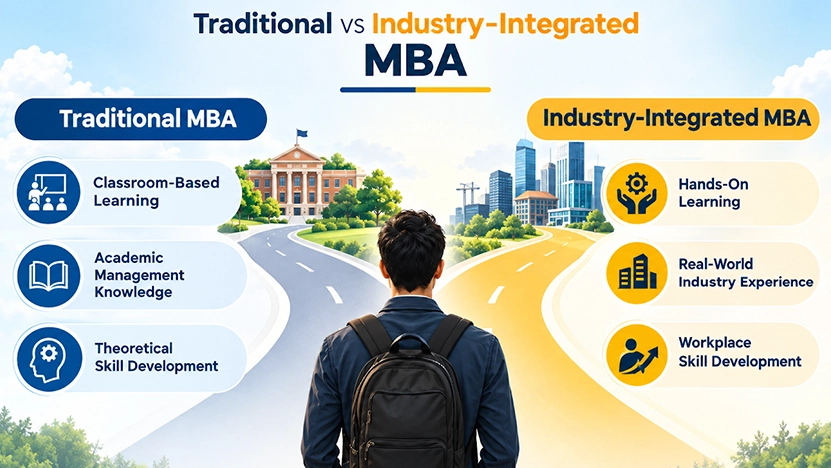
- Understand the differences between Traditional and Industry-Integrated MBA programmes.
- Compare academic learning with practical and industry-oriented exposure.
- Learn how internships, projects and industry interaction can build job-ready skills.
- Understand the factors that influence MBA career and employment prospects.
- Explore how each learning model can support different career goals.
- Learn why practical exposure can be useful for aspiring entrepreneurs and future business leaders.
- Understand what to consider before choosing an MBA programme.
Industry-Integrated MBA vs Traditional MBA: Key Differences
What is an Industry-Integrated MBA?
Industry Integrated MBA is an integrated management course that offers hands-on business experiences for students to put what they have learnt into real industry through projects, internships, industry interactions and real business activities.
What is a Traditional MBA?
A Traditional MBA is a structured academic approach dealing with management concepts, in-class learning, classroom discussion, case studies, assignments, presentations, assessments and exams.
Comparison of an Industry-Integrated MBA and a Traditional MBA
| Factor | Industry-Integrated MBA | Traditional MBA | Potential Hiring Impact |
|---|---|---|---|
| Learning Approach | Academic learning with practical application | Structured academic learning | Practical application can provide relevant examples for interviews |
| Industry Exposure | Integrated into the learning experience | Depends on the institution | Industry exposure can build familiarity with workplace expectations |
| Live Projects | Industry-oriented practical projects | Academic projects may be emphasized | Practical projects provide experiences to discuss with employers |
| Internships | Provides practical industry exposure | Availability varies by program | Relevant workplace experience can strengthen a graduate's profile |
| Corporate Interaction | Regular industry interaction may be included | Depends on the institution | Professional interaction can improve awareness of employer expectations |
| Mentorship | May involve industry professionals | Primarily faculty-led | Industry guidance can provide practical career perspectives |
| Business Challenges | Real-world problem-solving activities | More classroom-oriented activities | Applied challenges can demonstrate problem-solving experience |
| Skill Development | Practical and professional skills | Strong management and academic foundation | Demonstrable skills can support interview and recruitment readiness |
| Workplace Readiness | Emphasizes application and industry exposure | Depends on additional practical exposure | Practical experience may help graduates transition into professional roles |
| Networking | Peers, faculty, mentors, and professionals | Primarily peers and faculty | Broader professional interaction can create additional career connections |
Traditional vs Industry-Integrated MBA: Who Gets Hired Faster?
An Industry-Integrated MBA can give students an advantage when employers value practical experience, industry exposure and job-ready skills. However, the MBA format alone does not determine how quickly a graduate finds employment.
Internships, relevant project experience, communication skills, specialisation, institution quality, placement opportunities, interview performance and employer demand can all influence career outcomes
A Traditional MBA can also lead to strong employment opportunities when students build practical experience through internships, projects, certifications, case competitions, networking and placement preparation.
Note: An MBA qualification is only one part of career readiness. The skills you develop and the practical experience you gain while earning the qualification can also influence how prepared you are for employment.
What Do Recruiters Look for in MBA Graduates?
Recruiters may consider a combination of academic knowledge, practical experience and professional skills when evaluating MBA graduates.
| Graduate Strength | Why It Can Matter During Hiring |
|---|---|
| Management Knowledge | Demonstrates understanding of core business concepts |
| Practical Experience | Shows how knowledge has been applied |
| Communication Skills | Supports interviews and professional interaction |
| Problem Solving | Demonstrates ability to approach business situations |
| Decision Making | Shows structured thinking and judgement |
| Teamwork | Demonstrates professional collaboration |
| Project Experience | Provides practical examples for interviews |
| Industry Exposure | Builds familiarity with workplace expectations |
Skills Developed Through Industry-Integrated Learning
The Internships, live projects, industry interaction, business challenges and mentorship can be structured through an Industry-Integrated MBA. Through these experiences students can learn to apply management concepts and gain practical and professional skills
Who Should Choose a Traditional or Industry-Integrated MBA?
Choosing the right MBA is dependent on your career objectives, learning style and experience you seek while pursuing the course.
- Consider the Traditional MBA option if you value structured academic education and wish to emphasize management principles and a chosen concentration.
- Select Industry Integrated MBA if you need some exposure to business and management studies through projects, internships and industry interaction.
- Students who are looking to become entrepreneurs or business owners might find an Industry-Integrated MBA useful as it imparts knowledge related to marketing, finance, operations, HR and business development, as well as practical decision making in the context of business.
- If students are interested in working in broader business or management positions, they might like an Industry-Integrated MBA as they will be exposed to various business areas and understand how each area contributes to an organisation.
- For students who want to gain hands-on experience and work-ready skills in their MBA, an Industry-Integrated MBA course might be a better option, especially if it includes industry mentors, live projects, and business activities with internships.
- Depending on the course and institution, a Traditional MBA might be better suited for students who are mainly interested in acquiring depth in a certain area of management.
Want to Learn an MBA with Industry Exposure?
Aachi Business School offers an Industry-Integrated MBA that combines management education with practical business exposure. Students can develop management knowledge while gaining experience through internships, business challenges, industry interaction, mentoring and practical activities.
- Outbound training, weekly practice, business challenges, and expert led corporate training.
- Internships, part-time opportunities and industry visits, along with Earn While You Learn opportunities of up to ₹12,500 per month.
- Idea validation, business creation, and startup focused initiatives.
- Dedicated industry mentors provide career guidance and practical advice.
- Placement assistance, corporate connections, and career guidance.
- Affordable education with access to Aachi Group's corporate ecosystem.
All of these learning activities provide opportunities for students to relate management knowledge to real-world business situations. The Industry-Integrated MBA allows students to learn in class and gain hands-on experience through projects and internships, as well as build industry connections and receive industry guidance.
Join Now